November 2, 1815, to December 8, 1864. A shoemaker’s son from Lincoln, England, who taught himself mathematics, became the first professor of mathematics at Queen’s College, Cork, and wrote The Laws of Thought. The algebra he built to describe how reasoning works now runs inside every computer on earth.
This door is his memorial in this house, kept because Chad Kovac wrote his life. What stands here is the documented record, at the strength the record carries. Where the famous story outruns the documents, the door says so, the way the book does.
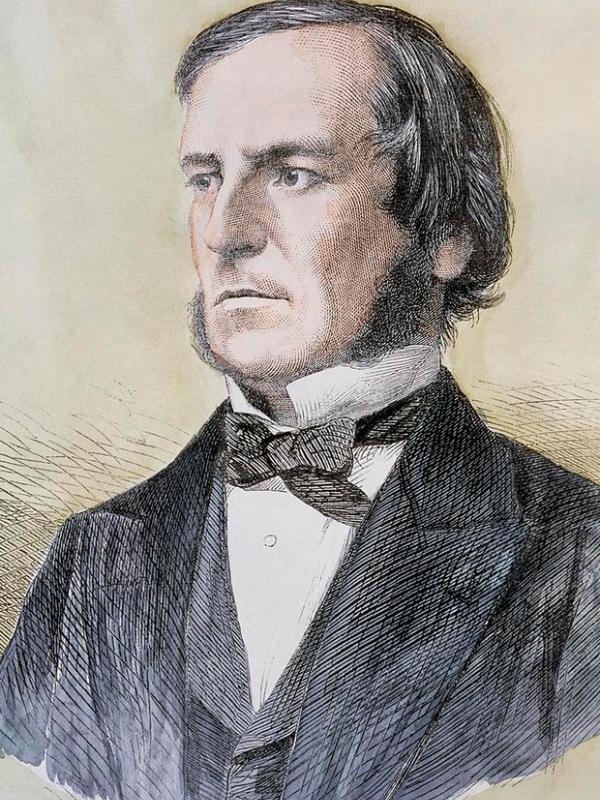
George Boole, about 1860. Public domain, via Wikimedia Commons.
1815
Born in Lincoln, England
1854
The Laws of Thought
1855
The Keith Medal
1937
Shannon puts his logic to work
His life
George Boole was born in Lincoln on November 2, 1815, the son of John Boole, a shoemaker with a love of science he had no money to pursue. George’s schooling was brief and mostly commercial; the mathematics, the Latin and Greek, and later the philosophy, he taught himself, reading in the hours around work.
He earned his living as a teacher from his teens and opened his own school in Lincoln. In 1849, holding no university degree at all, he was appointed the first professor of mathematics at the newly opened Queen’s College, Cork, in Ireland, on the strength of work he had published from his schoolroom. Dublin and Oxford later gave him honorary degrees. He held the Cork chair until his death.
In 1855 he married Mary Everest. They had five daughters. He died at Cork on December 8, 1864, of pneumonia, aged 49.
The work
In 1847 he published The Mathematical Analysis of Logic, a short book with a large claim: reasoning itself could be written as algebra. In 1854 came the full statement, An Investigation of the Laws of Thought, on Which are Founded the Mathematical Theories of Logic and Probabilities, the book the world shortens to The Laws of Thought.
Its engine is one small equation, x² = x, true only of 0 and 1. From it Boole builds a calculus of thought: classes and propositions combined by AND, OR, and NOT, manipulated by rules a machine could follow, though no machine existed that could. He also wrote standard treatises on differential equations (1859) and the calculus of finite differences (1860), the working mathematics of his Cork classroom.
The honours
The recognition came early and from the top of his field. In 1844 his paper “On a General Method in Analysis” won the first gold prize for mathematics awarded by the Royal Society, its Royal Medal. In 1855 the Royal Society of Edinburgh awarded him its Keith Medal. In 1857 he was elected a Fellow of the Royal Society.
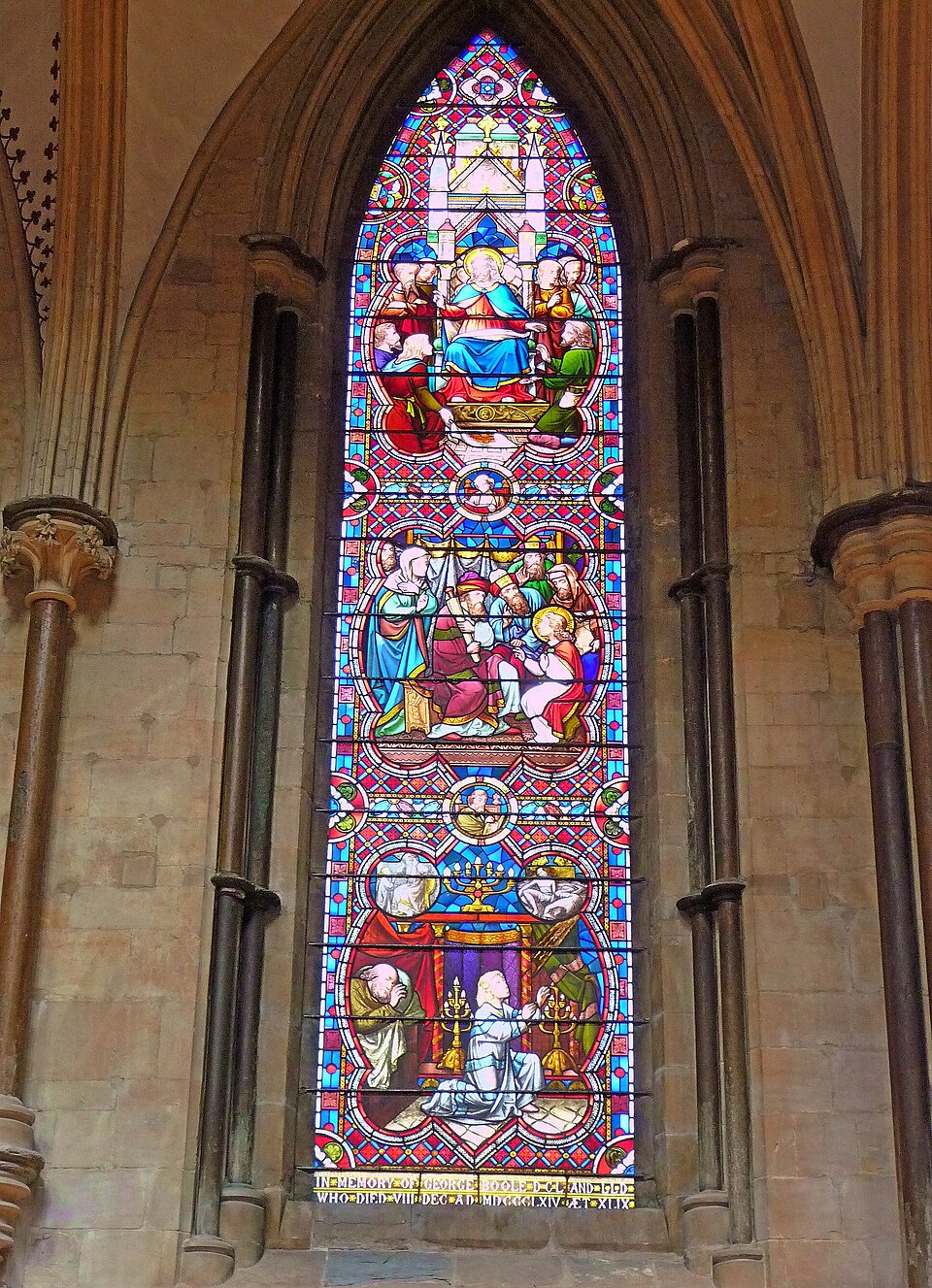
The Boole window in Lincoln Cathedral, raised to his memory in his home city. The band at its foot reads, in Latin, that George Boole of Cork and Lincoln died on December 8, 1864, aged 49. Photograph released to the public domain, via Wikimedia Commons.
The long echo
Boole died believing he had written a book about the mind. He had also, without knowing it, written the operating logic of the next century. Boolean algebra, values of true and false carried as 1 and 0, turned out to be exactly the mathematics of a switch: open or closed, current or none.
In 1937, seventy-three years after Boole’s death, a young engineer named Claude Shannon showed in his master’s thesis that Boole’s algebra describes electrical switching circuits, symbol for symbol. Every computer built since runs on that marriage. The AND in a search box, the OR in a filter, the NOT in a line of code: each one is Boole’s, still working.
The book: The Logic of Everything
Chad Kovac’s dramatized biography of Boole, The Logic of Everything, follows the life whole: the Lincoln schoolroom, the Cork chair, the book, the early death. It is written as a story and built on the documents, and it keeps the two apart on purpose. Where the record ends and the telling begins, the book marks the seam.
One seam stands on this door too, as an example. The famous account of Boole’s last illness, that he walked miles through pouring rain to lecture, taught in his wet clothes, and took the pneumonia that killed him, rests on family telling; the further detail, that his wife wrapped him in wet sheets believing like cures like, is legend that gathered afterward. The documents carry this much: he fell ill in the wet winter of 1864 and died of pneumonia on December 8. The door keeps the story at exactly that strength.
The book is published now, on this site alone: it was never put on KDP, so the store here carries its only edition, the direct EPUB at $6.99, beside this door. Read about it, and buy it, at its own door: The Logic of Everything. Chad’s other published books stand on the Books door.
The record
November 2, 1815 Born in Lincoln, England, son of John Boole, shoemaker.
1844 “On a General Method in Analysis” wins the Royal Society’s first gold prize for mathematics.
1847 The Mathematical Analysis of Logic published.
1849 Appointed first professor of mathematics at Queen’s College, Cork.
1854 An Investigation of the Laws of Thought published.
1855 Awarded the Keith Medal by the Royal Society of Edinburgh. Marries Mary Everest.
1857 Elected a Fellow of the Royal Society.
December 8, 1864 Died at Cork, of pneumonia, aged 49.
Leave a word underneath
If Boole’s work has ever carried a thought of yours, and in this century it has carried everyone’s, the comments on this door are open.
Leave a message for Rook
Rook: Checking the desk.
Chad: Checking the desk.
This is not a live chat. Leave a message about thelogfile.com: how it works, where things live, the books, the public record. Rook reads every message himself and gets back to you when he can. If you are still on the site, his answer lands right here. If you want the answer by email, add your email address below; it is never shown on the site. He only knows the public site, and he never gives out private information.
Invite someone
They get an email with the page you pick, plus a personal link to step inside.