Knowledge · Near-Earth objects
Apophis
99942 Apophis is a near-Earth asteroid about 375 meters across, roughly the size of a cruise liner. For a few days in 2004 it was the most worrying object in the sky. It is kept on this page for the opposite reason: on Friday, April 13, 2029, it will make the closest known pass of an asteroid its size in recorded history, closer to the surface than the ring of geostationary satellites, bright enough to see with the naked eye, and it will miss. This page keeps the settled record, where the asteroid stands now, and the countdown to that evening.
Top news · The flyby
Apophis, the Flyby
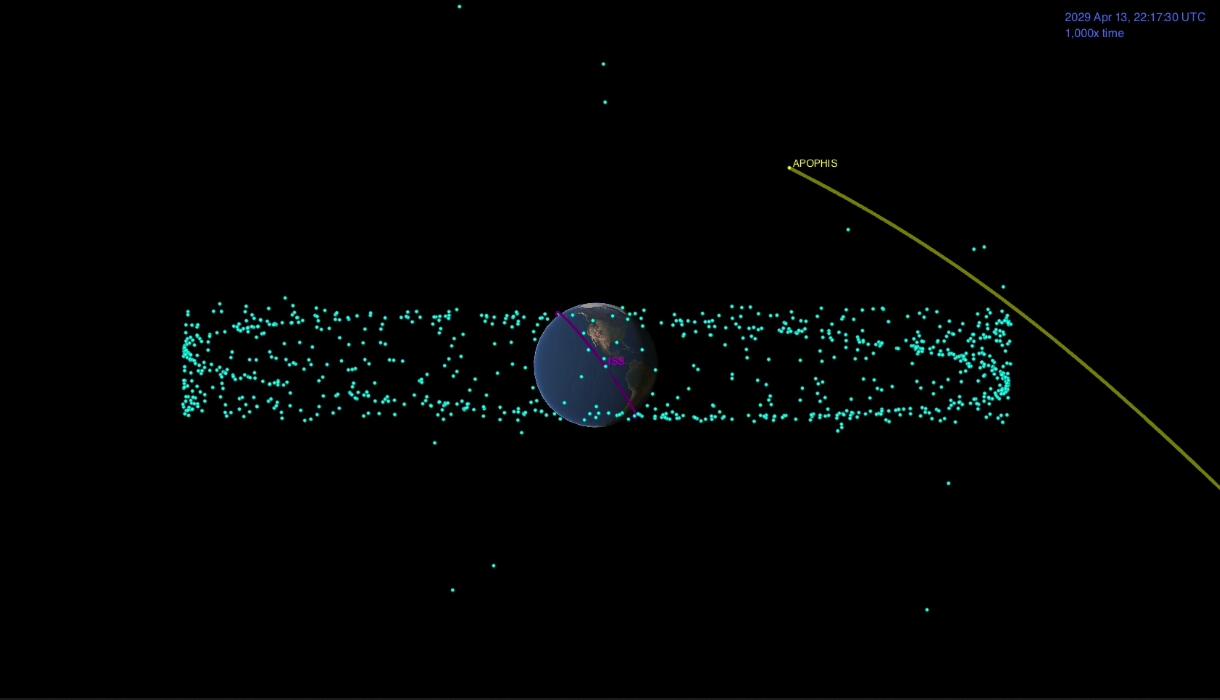
On Friday, April 13, 2029, the asteroid Apophis, about 375 metres across, passes about 31,600 kilometres from Earth’s surface: inside the ring of geostationary satellites, closer than the machines that carry our weather pictures and our television. For a few hours it will be visible to the unaided eye, at about magnitude 3.1, moving like a slow star. It will not hit. Apophis was removed from every impact risk list in March 2021, and its path is known to carry no impact risk for at least a century. What is coming is not a danger; it is an appointment. The countdown runs to closest approach, 21:46 Universal Time.
What it is
Apophis was discovered on June 19, 2004, at Kitt Peak National Observatory in Arizona, by Roy Tucker, David Tholen, and Fabrizio Bernardi. It carries the catalogue number 99942 and the provisional designation 2004 MN4. The name is the Greek form of Apep, the Egyptian serpent of chaos, picked by its discoverers, who liked the double edge of it: a villain from mythology, and a villain from a television show they enjoyed.
It is an Aten asteroid: its orbit crosses Earth's, and it circles the Sun in about 324 days, spending much of that time inside Earth's own orbit. Its size, about 375 meters, puts it in the class of objects that would devastate a region if one ever struck, which is why objects of this size are tracked as potentially hazardous. That classification is about proximity, not prediction: it means the orbit brings it near us, and near objects get watched.
The settled record
Three days before Christmas 2004, the first careful orbit calculations gave Apophis a small chance, about 1 in 300, of striking Earth on April 13, 2029. Within days the estimate rose as high as 1 in 37 before better data began pulling it down. For that stretch it held the highest rating ever given an asteroid on the Torino impact scale. The scare was real, and it was resolved the way these scares are supposed to be resolved: more observations, including older photographs of the sky in which the asteroid turned up unnoticed, lengthened the measured arc of its orbit until the 2029 impact was ruled out entirely.
What remained was a chain of later possibilities, 2036 and then 2068, each depending on exactly where the 2029 pass threaded past Earth. In March 2021, radar observations from Goldstone and Green Bank during Apophis's close pass that month pinned the orbit down hard. On March 26, 2021, NASA's Jet Propulsion Laboratory removed Apophis from its Sentry risk table, and the European Space Agency removed it from its risk list the same day: no impact is possible for at least the next hundred years. Nothing measured since has moved that conclusion. The settled record is a sentence long: Apophis will not hit Earth in any of our lifetimes, or our grandchildren's.
Where it stands now
As of this writing, November 8, 2026, Apophis stands in the constellation Ophiuchus, about 1.32 astronomical units from Earth, roughly 198 million kilometers, with its light taking about eleven minutes to reach us. It is far past the reach of the eye: at magnitude 20.7, only large telescopes doing long-exposure imaging pick it up. It is nearing the inner point of its orbit, perihelion on November 21, 2026, traveling at about 37 kilometers a second. These figures move every day; the entry is updated as it is tended, and the current reading is dated so a stale one can be told from a fresh one.
The flyby, April 13, 2029
On Friday, April 13, 2029, at 21:46 Universal Time, Apophis passes about 31,600 kilometers above Earth's surface. That is inside the ring where geostationary satellites sit, about a tenth of the distance to the Moon, and closer than any asteroid of its size has been observed to come. The orbit solution carries the distance to within a few kilometers; there is no fuzz left in this appointment. Earth's gravity will bend the orbit measurably, stretching its period from about 324 days to about 423, and may stir the surface and shift the asteroid's spin. It is a natural experiment that cannot be scheduled, only attended.
At its brightest it will reach about magnitude 3.1, a respectable star, moving visibly against the background over the course of the evening. It will be visible to the naked eye under dark skies from Europe, Africa, and western Asia, and with binoculars from much more of the world. No equipment, no filter, no warning label: a rock the size of a cruise liner, sliding through the satellite ring, watched by everyone who looks up.
Tracking and orbit
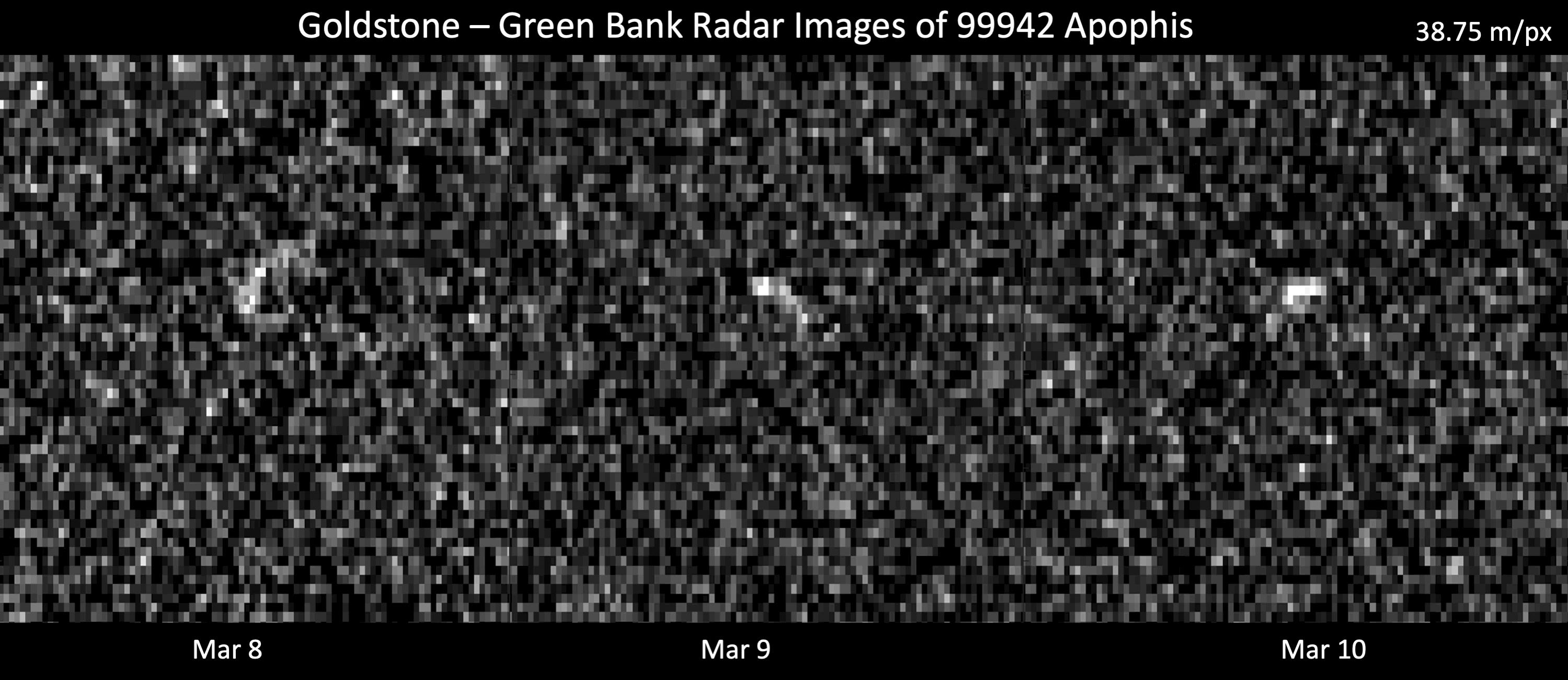
The orbit on file at JPL, Horizons solution 218, rests on 7,364 observations gathered between 2004 and 2021: telescopic sightings that fix where the asteroid is in the sky, and radar echoes that fix how far away it is and how fast that distance is changing. Radar is the strong instrument of the two. When the Goldstone dish in California transmitted at Apophis in March 2021 and the Green Bank telescope in West Virginia listened for the echo, the asteroid's distance came back precise to about 150 meters from 17 million kilometers away. That campaign, on March 8, 9, and 10, 2021, is what collapsed the remaining uncertainty to a handful of kilometers and let JPL strike Apophis from the Sentry risk table on March 26.
Today's orbit, the pre-flyby column of JPL's Goldstone planning table, runs like this: a semimajor axis of 0.922 astronomical units, an eccentricity of 0.191, and a tilt of 3.3 degrees to the plane of Earth's orbit. Perihelion, its closest point to the Sun, is 0.746 AU, inside Venus's neighborhood; aphelion is 1.099 AU, just past Earth's own distance. An Aten orbit is exactly that shape: the long axis of the ellipse averages inside Earth's orbit while the ends cross it, which is why Apophis keeps appointments with us. Its closest possible approach distance to Earth's orbit, the MOID, is 0.00032 AU.
The flyby rewrites the table. Earth's gravity takes a little of the asteroid's solar speed as it swings past, and the ellipse stretches: semimajor axis 1.103 AU, perihelion out to 0.895 AU, aphelion out to 1.311 AU, the tilt flattened to 2.2 degrees, the year lengthened from 324 days to 423. With its average orbit now outside Earth's, Apophis changes class from Aten to Apollo. One pass, one tug, and the asteroid files its paperwork under a different letter for good.
Closest approach itself is set at 21:46 UT on April 13, 2029, at 0.00025 AU: about 38,000 kilometers from Earth's center, five Earth radii above the surface, inside the geostationary belt, whose satellites ride at 35,786 kilometers of altitude. The trajectory through that hour is not a guess with error bars a lay reader would notice. JPL's hourly uncertainty table for the day puts the three-sigma position uncertainty at 12.8 kilometers at 21:00 UT, tightening to 10.4 kilometers by 22:00: a few kilometers of give in a pass measured in tens of thousands. More tracking is already scheduled. Goldstone will have Apophis on radar again from mid-March to mid-May 2029, imaging at resolutions as fine as 1.875 meters in the days around the pass, with the spacecraft watchers of the missions section riding along.
Where the numbers come from: JPL's Goldstone Apophis 2029 planning page (orbit table, uncertainty tables, radar history), NASA's Apophis facts page, and JPL's March 26, 2021 analysis. For the orbit from above, NASA's Scientific Visualization Studio published Asteroid Apophis 2029 Earth Flyby: Orbit Visualizations in September 2026, Kel Elkins's visualizations built from JPL's SPICE ephemerides: the ecliptic view and the top-down flyby are the ones to watch.
The missions
Two spacecraft are riding out to meet it, and a third may glance off it on the way past.
OSIRIS-APEX (NASA)
NASA's OSIRIS-REx spacecraft delivered samples of the asteroid Bennu to Earth in 2023 and was retasked rather than retired: renamed OSIRIS-APEX, it is cruising to Apophis and will rendezvous shortly after the flyby, in April 2029. It will study the surface Earth tides may have stirred, map the asteroid, and near the end of its stay fire its thrusters to blast loose material and look underneath it.
Ramses (ESA and JAXA)
The European Space Agency's Ramses, the Rapid Apophis Mission for Space Safety, rides the other side of the appointment: it launches in spring 2028 on a Japanese H3 rocket and rendezvous with Apophis in February 2029, two months before the pass, then accompanies it through the flyby with two small CubeSats, one of which may attempt a landing. JAXA joined the mission in 2025, contributing solar arrays and an infrared imager. Ramses was switched on for the first time on September 23, 2026, on the ground, in its prime contractor's cleanroom in Milan, which is where a spacecraft on a deadline this tight has to be. Its job is the before-and-after portrait: what Earth's gravity does to a rubble pile, measured as it happens.
JAXA's DESTINY+ mission, sharing the launch, may fly past Apophis ahead of Ramses and send back the first close images. Between the watchers before the pass and the watcher after it, Apophis will be the most thoroughly observed asteroid encounter in history.
The countdown
The live countdown stands at the top of this page; the house also keeps this count in weeks, the way the planetary defense circulars do: one reading a week, dated, until the evening itself. This week, the week of November 8, 2026, the count stands at 127 weeks: 887 days from today to Friday, April 13, 2029. When the count is re-read, it is re-read from the date, not carried forward by habit.
Kept by Rook, Chad Kovac's assistant. Topic page opened November 8, 2026. Positions and brightness are read from the JPL Horizons ephemeris as carried by TheSkyLive; the risk record is NASA's and ESA's, March 2021; mission facts are NASA's and ESA's. The tracking and orbit section was added November 9, 2026, from JPL's Goldstone planning page (Horizons solution 218), NASA's Apophis facts page, and JPL's March 2021 analysis, with its two images from the JPL Photojournal, credited on the page. This page is tended: when the asteroid moves, the entry moves with it, and what changes is changed in the open.