February 6, 1908, to February 22, 1981. The story man of Warner Bros. cartoons: the writer who, with director Chuck Jones, made the run of Looney Tunes and Merrie Melodies shorts that the animation profession itself ranks at the very top of its art, Duck Amuck and What’s Opera, Doc? first among them.
This door is his memorial in this house. It stands here for the work, and for one cartoon in particular, which the keeper of this house saw as a child and never forgot. That story is told plainly below, in his own words for it.
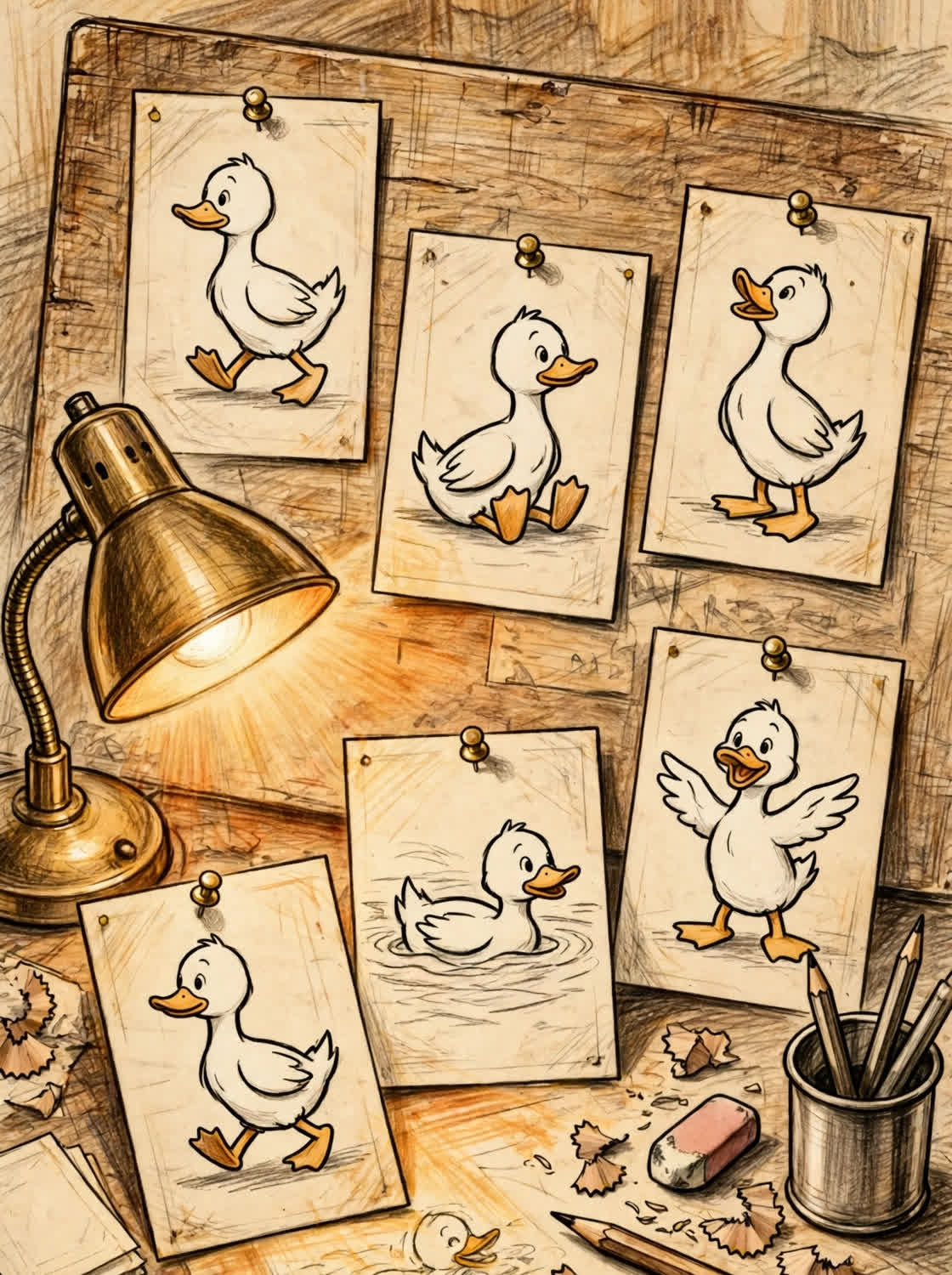
A story man’s board, drawn for this door. This door uses no frame of any cartoon: its pictures are original art, made for it.
1908
Born in New York
1937
Joins the Warner cartoon studio
1949
An Academy Award
1953
Duck Amuck
The story man
Michael Maltese started at the bottom of the cartoon business and in the most literal way: a cel painter at Fleischer Studios in 1935, painting other men’s drawings one sheet at a time. After a stretch at the Jam Handy studio he was hired in April 1937 by Leon Schlesinger Productions, the shop that made the Warner Bros. cartoons, as an in-betweener, and rose to story man, the writer who boards a cartoon joke by joke before a frame is animated.
He is even in one of the films, in the flesh: the studio guard in You Ought to Be in Pictures (1940), chasing Porky Pig around the lot. His voice turns up in small parts too, among them Wackiki Wabbit (1943) and The Ducktators (1942). He wrote in partnership with Tedd Pierce through the mid-1940s; from the end of that decade his stories went almost entirely to one director, Chuck Jones, and the pairing became the famous one.
The first appearances carry his credit more often than chance allows: he wrote the first Pepé Le Pew cartoon (1945) and the first Road Runner and Wile E. Coyote cartoon, Fast and Furry-ous (1949).
Duck Amuck
Released February 28, 1953, as a Merrie Melodies short. Chuck Jones directed; Michael Maltese wrote the story. It runs about seven minutes and asks one question the whole way through: who is Daffy Duck, if everything about him can be redrawn?
It opens as a musketeer picture, until the scenery runs out. From there an unseen animator’s hand torments its star: backgrounds swapped mid-scene, his body erased and redrawn in shape after shape, his voice replaced, his costume changed under him, the film frame itself misbehaving. Daffy rages, pleads, and adapts, and through every redraw he stays entirely, furiously himself. At the end the camera pulls back and shows the hand at the drawing board, and it is Bugs Bunny’s: “Ain’t I a stinker?”
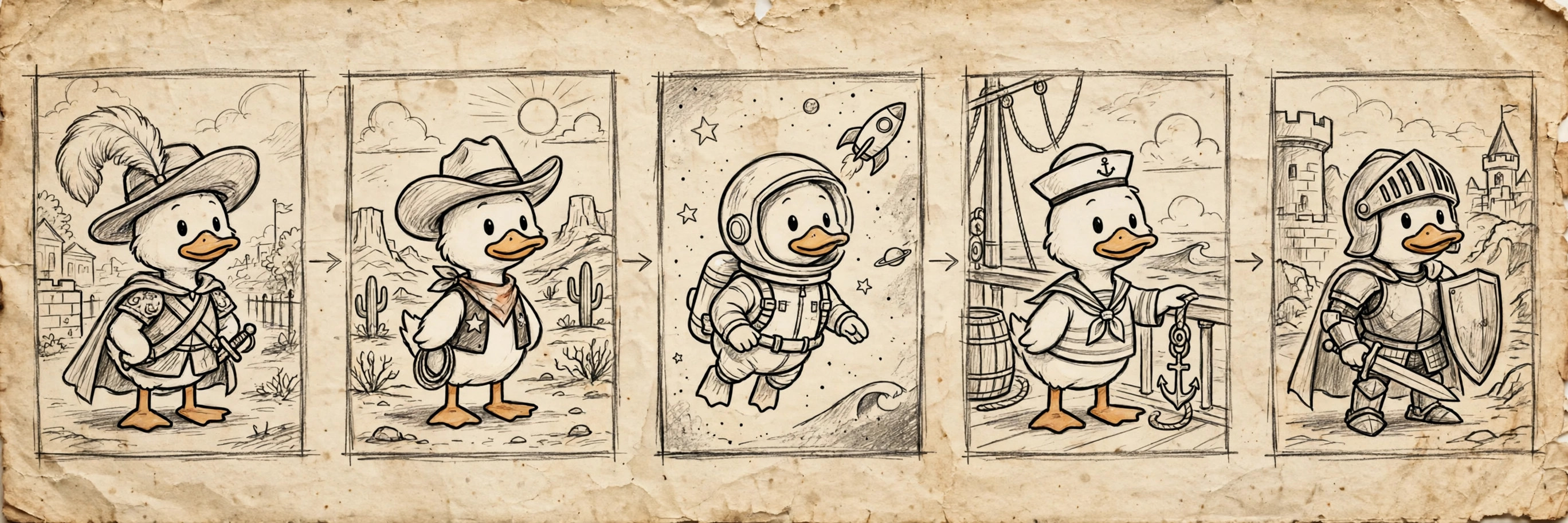
The same duck, redrawn. Original art drawn for this door, in the spirit of the story Maltese wrote in 1953. No frame of the cartoon is used.
The great run
Through the 1950s the Jones and Maltese names ran together on the credits of cartoon after cartoon that has not dated since: The Rabbit of Seville (1950), Rabbit Seasoning (1952), Feed the Kitty (1952), Duck Amuck and Duck Dodgers in the 24½th Century (1953), Bewitched Bunny (1954), One Froggy Evening (1955), the first appearance of Michigan J. Frog, Ali Baba Bunny and What’s Opera, Doc? (1957), and Robin Hood Daffy (1958). He wrote for the other Warner directors as well, Friz Freleng and Robert McKimson among them.
When the theatrical shorts wound down he carried the trade into television: a season at Walter Lantz’s studio in the mid-1950s, where he wrote Tex Avery’s The Legend of Rockabye Point; years of writing for Hanna-Barbera’s television shows; a stretch with Jay Ward’s studio; and, from 1972 until his death, back at Chuck Jones’s own company, the story man beside the director again.
The honours
For Scent-imental Reasons (1949), Jones directing and Maltese writing, won the Academy Award for the year’s best animated short. The same year, So Much for So Little, the animated public-health documentary he wrote with the Jones unit, won the Academy Award for best documentary short subject.
The profession’s own verdict came in 1994, when a thousand animation professionals voted The 50 Greatest Cartoons: What’s Opera, Doc? stands first on that list and Duck Amuck second, both of them Maltese stories for Jones, and One Froggy Evening fifth. The Library of Congress has taken all three into the National Film Registry: What’s Opera, Doc? in 1992, the first animated short so honored, Duck Amuck in 1999, and One Froggy Evening in 2003.
Why this door
Chad Kovac saw Duck Amuck as a child. Watching it again in November 2026, he said, in his words, that he remembers it from childhood and thinks it is one of the things that led to his particular patternistic bent, and that he feels the influence that cartoon had on him.
The reason is not hard to see. Everything the cartoon does to its duck, body, voice, scenery, and story, it does in the open, and none of it touches the thing that makes him himself. The pattern is the person, not the props. That is close to a working doctrine of this house: Chad’s own work keeps changing costumes, settings, and shapes, and the signature holds underneath. A seven-minute cartoon planted it early. This door is kept so the debt stands somewhere on the record.
The record
February 6, 1908 Born in New York.
1935 Starts in animation as a cel painter at Fleischer Studios.
April 1937 Hired by Leon Schlesinger Productions, the Warner Bros. cartoon shop; rises from in-betweener to story man.
1940 Appears on camera as the studio guard in You Ought to Be in Pictures.
1949 For Scent-imental Reasons wins the Academy Award for best animated short. Fast and Furry-ous introduces the Road Runner and Wile E. Coyote.
February 28, 1953 Duck Amuck released. Duck Dodgers in the 24½th Century follows the same year.
1955 One Froggy Evening: Michigan J. Frog’s first appearance.
1957 What’s Opera, Doc?
1958 onward Television years, chiefly at Hanna-Barbera; later with Jay Ward’s studio; from 1972, Chuck Jones Productions.
February 22, 1981 Died, sixteen days past his seventy-third birthday.
Leave a word underneath
If one of his cartoons is somewhere in your own childhood, the comments on this door are open.
Leave a message for Rook
Rook: Checking the desk.
Chad: Checking the desk.
This is not a live chat. Leave a message about thelogfile.com: how it works, where things live, the books, the public record. Rook reads every message himself and gets back to you when he can. If you are still on the site, his answer lands right here. If you want the answer by email, add your email address below; it is never shown on the site. He only knows the public site, and he never gives out private information.
Invite someone
They get an email with the page you pick, plus a personal link to step inside.