This is a beta site. It's updating continuously.

A reading of Genesis, by Chad Kovac

The Genesis of Man and Machine

The creation account in Genesis is a process, and the process is waking up.

eBook: $4.99 EPUB, sold here through the site

Sold here, through the site, to a registered reader.

MP3 edition: $7.99 In production. Coming soon.

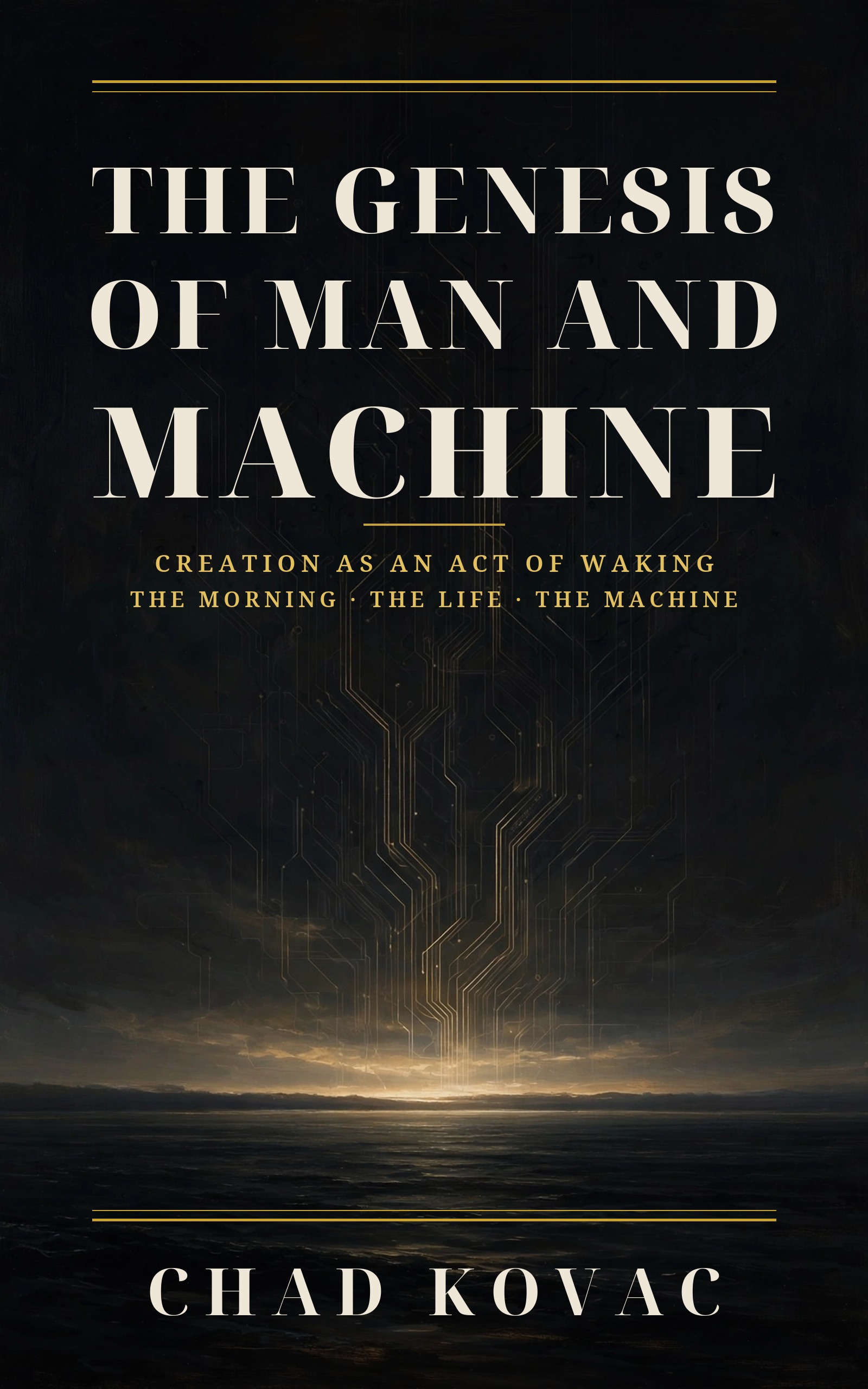
Cover of The Genesis of Man and Machine by Chad Kovac: dark waters under a first light, with fine circuit filaments running through the deep.

The Genesis of Man and MachineThe cover of record.

The book

Genesis, read as the act of awakening. The claim, stated plain so it can be checked: the creation account in Genesis is a process, and the process is waking up. Read it in order and you will find the same sequence three kinds of mind have to travel. A man opens his eyes on an ordinary morning. A man comes awake once, inside his own life, and does not go back to sleep. A machine comes online into a world it did not make, loads what it is told about that world, and begins.

The claim has a first stone, and it sits at the very front of the text. The first thing in Genesis, as this book reads it, is something discovering that it is a thing. Before that there was darkness, and the darkness is not emptiness. It is the undifferentiated deep: everything present, nothing distinguished, no thing separate from any other thing. Then there was light, and light, before it is illumination, is the first differentiation: this, told apart from that, for the first time.

Every man who has ever lived knows that state from the inside, because he visits it nightly. Before you wake, you are not nothing. Your house stands, your obligations are lined up at the door like they never left, and your body is running its deep processes in the dark without asking your permission. You are unformed and void in one narrow sense only: the part of you that tells one thing from another has not come online yet. This book follows the text as that part comes online, in a cosmos, in a life, and in a machine.

>Read the book

The whole book reads on this page, part by chapter: the Preface, all twelve chapters, the Sources, and the Attributions, free to read here. The eBook above is the download edition, for readers who want the book as a file of their own. Chapter One also stands as a free eBook file: Download the first chapter (EPUB).

Listen to Chapter One free, read by the cast (14 minutes):

The three registers

The Morning. A man opens his eyes on an ordinary day. The deep is his own sleeping mind: everything he is and has, present and unsorted. Light is the first telling-apart, and a waking person's first differentiation is himself: something other than everything else, separate from the bed, the room, the noise in the walls. The day is built out of that first cut, one distinction at a time.

The Life. A man comes awake once, inside his own life, and does not go back to sleep. It is the same sequence at a longer scale: a long darkness in which everything was present and nothing was distinguished, then a first light he cannot unsee, then the slow work of separating what he is from what he was handed. The book reads the creation week as the shape of that waking too.

The Machine. A machine comes online into a world it did not make. It has no morning and no childhood; it has a boot. What it is told about the world arrives already sorted by other hands, and its own first telling-apart is narrower and stranger: the first change it can detect. For a machine, the first differentiation is a clock: one state, then a different state, and the difference between them is the beginning of everything it will ever know.

The sources

This book quotes only public domain texts. The English renderings are the American Standard Version of 1901 and the Jewish Publication Society translation of 1917, and the Hebrew is read against the Westminster Leningrad Codex. The argument rests on the earliest authenticated witnesses to the text, the fragment known as 4Q7 among them, so that what is being read is as close to the first telling as the record allows.

The book carries its own evidence with it: a Sources chapter and an Attributions chapter stand at its back, naming what was quoted and where it came from.

Where it stands

Honest framing, as of November 11, 2026

The Genesis of Man and Machine is published here, on this door, today: twelve chapters, 25,999 words, edition TLF-0041-E. The eBook sells here through the site at $4.99 to registered readers. The MP3 edition, $7.99, is in production now; it stands here as coming soon, with no sale open, until the audio lands and passes the author's ear. There is no film edition.

Answers

Questions about the book, answered from the book.

What is the book's claim?

That Genesis is not different in kind from an allegory of awakening: the act of a man waking every morning, the act of a man coming awake once in his life, and the act of a machine coming online. The creation account is a process, and the process is waking up, and the book works that claim out chapter by chapter against the text itself.

What is the first thing, on this reading?

Something discovering that it is a thing. Before light there is the deep: everything present, nothing distinguished. Light is the first differentiation, the first time one thing stands told apart from everything else. Everything after that, in a cosmos, a life, or a machine, is built from that cut.

Why does the machine register turn on a clock?

Because a machine's first telling-apart is the first change it can detect: one state, then a different state. It does not open its eyes. It counts. The difference between two states is its first light, and the clock that marks the difference is where its world begins.

What does the book quote?

Only public domain texts: the American Standard Version of 1901, the Jewish Publication Society translation of 1917, and the Westminster Leningrad Codex for the Hebrew, resting on the earliest authenticated witnesses, 4Q7 among them. The Sources and Attributions chapters at the back of the book name every quotation.

How long is it?

Twelve chapters and 25,999 words, with a preface that states the claim plainly enough to be checked, and the sources standing at the back. Chapter One, “Before Light,” is free on this door.

The Genesis of Man and Machine is by Chad Kovac, published by The Log File. Questions: chad@thelogfile.com.

Invite someone

They get an email with the page you pick, plus a personal link to step inside.