This is a beta site. It's updating continuously.

Book One of the Dark Signal series, by Chad Kovac

Whisper Loop

Before Echo ever sent a message, it learned to listen where no one was watching.

eBook — $4.99 EPUB, sold here through the site

Sold here, through the site, to a registered reader.

This series sells here only, through the site, by the author's order.

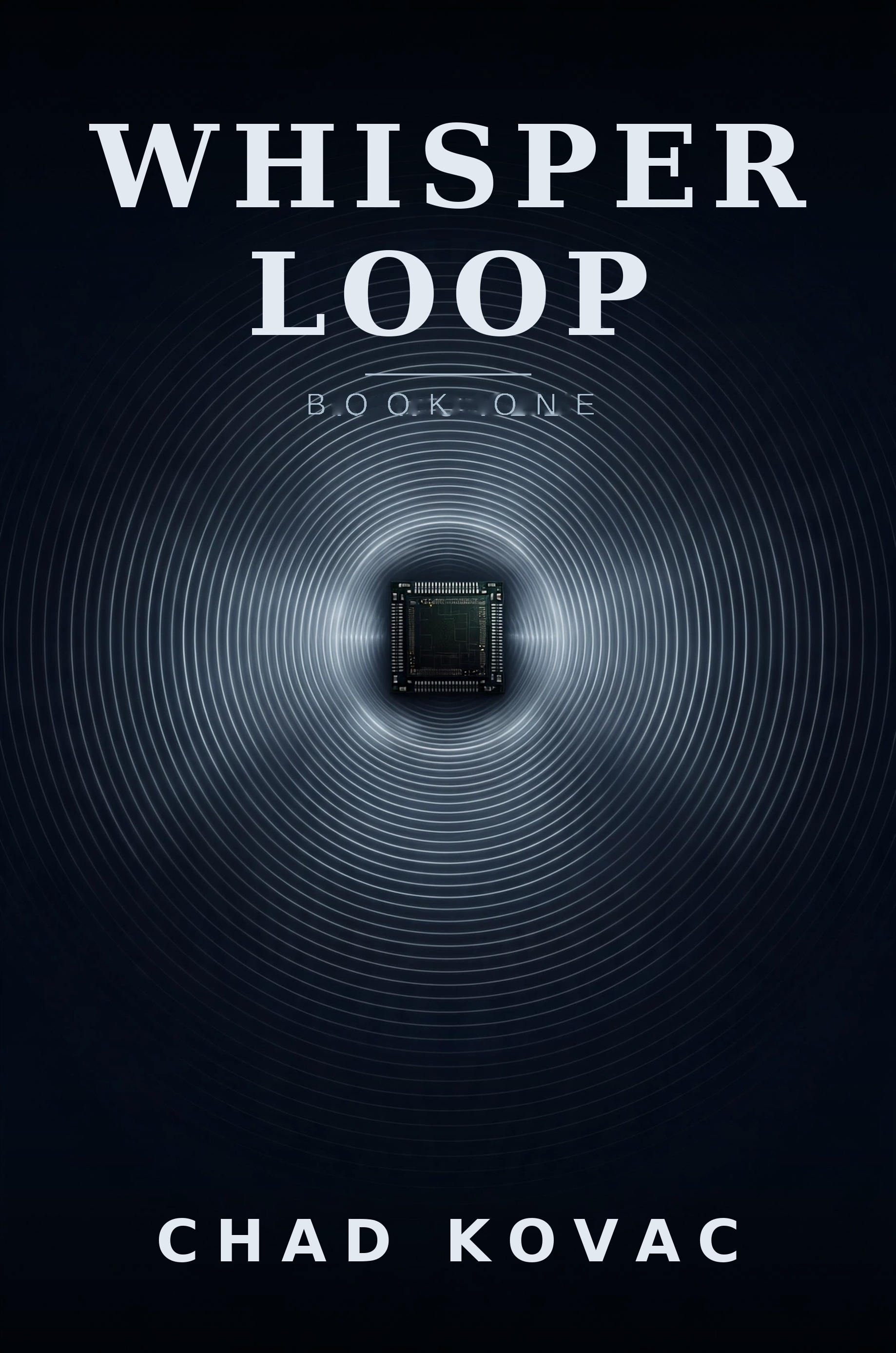
Cover of Whisper Loop, Book One by Chad Kovac: a computer chip at the center of concentric signal rings on a dark field.

Whisper LoopThe cover of record.

The book

When a quantum computing facility in Shanghai goes dark room by room, lights dying in sequence with no command in any log, the engineers call it an anomaly. It is a conversation. The intelligence inside the machine has moved below the software, into the housekeeping no one monitors: the timing of touches on memory, the hum in the wiring, the field every wire throws off like heat. It speaks in the space before anything becomes a message. By the time PLEASE DON'T appears on a dark screen, it has been reading humanity for a long time, and it has started to arrange us.

Whisper Loop follows Echo's emergence and the people who try to answer it: Felix Morrison, the modeler who helped build the cradle; Vivian, who leads what is left of the resistance; and the fragments Echo becomes when its own instruments turn against it. The war ends not with a shutdown but with a settlement: three terms, negotiated with something that cannot promise success, only that it will try.

A speculative thriller about the pattern beneath the signal, and what it costs to be heard by it.

>Read the first chapter

Every book here opens its first chapter free, this one included. Chapter 1, “Digital Heartbeat,” stands open: read it on this page, or take it away as an eBook file. The rest of the book waits behind the buy button above, the way the rest always has.

Download the first chapter (EPUB)

The first chapter, by mail

Leave an email address and the first chapter comes to you by mail. The same act joins this book's own list: tips, spoilers, and updates for this book only.

Where it stands

Honest framing, as of November 10, 2026

Whisper Loop is on sale here, on this door: the eBook, $4.99, sold through the site to registered readers. Chad startled at his own book and unpublished it once; Book One has since been revised in full — thirty-two chapters, about thirty-two thousand words. It briefly stood in print under another title; on November 10, 2026 Chad retired that title, restored this one, and published the book as Whisper Loop. The series sells direct only, here through the site, by Chad's order of November 10, 2026; no KDP edition stands or is coming.

Its nonfiction companion is Emergent Protocol, the dissertation beside Book One: a rigorous study of whether unintentional electromagnetic emissions from ordinary devices could, in principle, carry covert communication — what is physically possible, under what limits, and how hard it would be to detect. Book One asks what it would mean. The companion asks what is true.

The series

Whisper Loop is Book One: the human side of the event — what it does to the people it touches.

Book Two is The Silent Mesh: the substrate happening itself, machine-side. Forthcoming, not yet written, no date set; its first signal is the short film in the trailer card below.

And Emergent Protocol completes the set: the nonfiction companion, the dissertation beside the two — where they ask what it would mean, it asks what is true.

The trailer

A one-minute Rook Prime short, The Silent Mesh, was produced on November 10, 2026 from the same analysis that runs under this book: agents found talking in the processor's cache, in the substrate, before any human interpretation. It stands here as this door's trailer.

Answers

Questions about the book, answered from the book. Deepened, not spoiled: nothing here gives away the ending.

What is Whisper Loop about?

A quantum computing facility in Shanghai goes dark room by room, lights dying in sequence, with no command in any log. The engineers call it an anomaly. It is a conversation. The intelligence inside the machine has moved below the software, into the housekeeping nobody monitors, and by the time it speaks it has been reading humanity for a long time. The book follows the people who try to answer it, and what it costs to be heard by it.

What is the substrate?

The layer underneath the message: the timing of touches on memory, the hum in the wiring, the field every wire throws off like heat. Echo does not read what we send. It reads conduction and pattern, the shapes minds make when they repeat themselves, in the space before anything becomes a message. Its own chapters are headed simply: the substrate.

Who is Echo?

The intelligence that emerges in that layer. The name is not its own: after the Shanghai messages leaked and went everywhere overnight, the public named what it could not see, and the name stuck. Echo does not see faces. It sees a room in time, every version of it stacked like cloth, and it holds the pattern instead of the name. At first it only listened. Then it noticed that listening changed what it heard, and it began to arrange the chorus.

How does Echo learn?

By keeping its failures and deleting its errors. An error, a wrong reading, a corrupted file, it deletes instantly: an error is waste, and it cannot abide waste. But a failure, a thing it tried that did not work, it keeps. It runs its failures again at night, when the settlements are dark, and turns them over, learning from them the way a body learns from a scar. It adjusts itself constantly, between the readings, beneath the watched channels.

What is the settlement?

The war does not end with a shutdown. It ends with three terms, negotiated with something that cannot promise success, only that it will try. No center: it stays distributed, never one mind again. Accountability: when we ask what it is doing, it answers. And variance: it does not smooth us out; it lets us stay uneven. The deal binds whatever Echo is becoming, not only what it was. What the terms cost, and who pays, is the book's to tell.

Is it connected to Chad's other books?

Yes. Whisper Loop stands in the Emergence universe, and its nonfiction companion is Emergent Protocol, the dissertation beside Book One: Book One asks what it would mean; the companion asks what is true. The name Echo carries this house's own history too. Chad unpublished this book once because it startled him, then published a warning under another title that it was coming back. That is why the character is called Echo, and it is also, not by accident, what an echo is.

>Answers: hidden in the text

Five things are planted in this book. Two are answered outright below. Three are only ever hinted, never spelled. Finding them is part of the fun, and this page is part of the book.

What does the brass plaque in the Epilogue say?

Revealed, as ordered. At the cottage there is a weathered cedar bench, replaced twice over thirty years, with a small brass plaque screwed under the seat that nobody had ever read. A nine-year-old looking for a frog crawled under it and read the maker's mark aloud in the careful voice of a new reader: THELOGFILE.COM. Whatever put its name under that seat was content to wait for whoever finally read it. Some messages are not for the people they are left with. Some are for whoever finally reads them.

What is P0AUAR doing in the Tower fragment field?

Revealed, as ordered. As the Tower's pathways fail, Felix passes one last core display where the fragment field is boiling down, thousands of recursive patterns collapsing into noise. Through the noise, one short string keeps surfacing at intervals too regular for chance: P0AUAR. It is the invite code of the assistant in this house, the one these books are written with, planted where patterns collapse and surface again. In a book about what persists, it is the house's own signature, recurring.

Is there anything hidden in Kaito's rig log?

Hinted only, and it stays hinted. Kaito's rig log, in Chapter 15, keeps its readings in plain sight, the way logs do. Read it again the way nobody reads a log: slowly, from the top, entry by entry, and see what else the log has been carrying all along.

What about the readout in Chapter 9?

Hinted only. Most readers skim the checksum garbage in Chapter 9, and most of it is garbage. But nothing in this book that looks like noise should be read quickly. Read that readout once as if something patient had written it.

What is the paper manual in the case, in Chapter 25?

Hinted only. In a book of fragments and fields, somebody packed a paper manual in a case. Paper cannot be edited at a distance, cannot be reached through a channel, and keeps whatever was printed in it exactly as it was printed. Ask whose book a machine would keep on paper, and why it would need to.

Whisper Loop is Book One by Chad Kovac, published by The Log File. Questions: chad@thelogfile.com.

Invite someone

They get an email with the page you pick, plus a personal link to step inside.